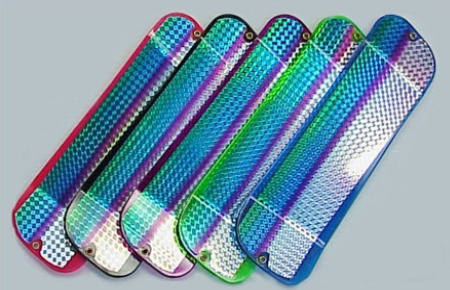
Many companies manufacture fishing
lures and baits of bright fluorescent colors and position these products
in the consumer markets as effective tools to attract and catch fish.
However, numerous scientific, technical and applied investigations and
recreational fishing practice show that these assertions are, as
minimum, exaggerated.
In general case, fluorescence is an
optical phenomenon when molecules of some substances absorb light in the
ultraviolet or visual parts of the electromagnetic spectrum and
immediately re-emit it with the longer wavelength. Because the falling
light is partly reflected by these substances and the reflected light is
mixed with the light of fluorescence, the eyes of human and animals (if
they have color vision) perceive the total colors of these substances
as “more bright”.
Spectral sensitivity
Fresh waters are optically more turbid
than sea waters, so the maximum of spectral sensitivity in freshwater
fish is shifted to the red part of the visual spectrum. In bluegill
sunfish, Lepomis macrochirus, for example, the maximum
of spectral sensitivity is shifted to 620-640 nm (orange part of the
spectrum) (Hawryshyn et al., 1988). According to Kawamura &
Kishimoto (2002), the maximum of spectral sensitivity in largemouth
bass, Micropterus salmoides, is shifted even to 673 nm (red
part of the spectrum). It means that for freshwater fish red and orange
colors are brighter than other colors, in full contradiction with the
perception of saltwater fish and human.
This red or orange shift of the maximum of spectral sensitivity is typical for other freshwater fish (Protasov, 1978).
Turbidity
Turbid waters decrease overall
intensity of ambient light, decrease via scattering an ability of
receivers to resolve silhouettes and more (for review, see Utne-Palm,
2002). In particular, turbidity affects color perception of freshwater
fish, their color patterns and communication with the assistance of
color signals.
For example, with an increase in turbidity of habitat males of red shiners, Cyprinella lutrensis, develop more intensive red fins (Dugas & Franssen, 2011). According to Kelley et al. (2012), rainbowfish, Melanotaenia australis, in the dissolved organic matter treatment show an increase in the area and brightness of their orange striped patterns.
More generally, turbidity weakens color
signals in inter-sexual selection (Seehausen et al. 1997), even
limiting species recognition in mate choice.
Fluorescent colors underwater
Overall, fluorescent colors are
brighter than ordinary colors and are more visible underwater (Kinney et
al., 1967). In turbid water (like Thames river), orange fluorescent
color is most visible for the human’s eye than other colors.
Other animals
For fruit fly, Anastrepha suspensa, traps of orange fluorescent color are more attractive than traps of ordinary orange color (Greany et al., 1978).
Dull males versus bright males
Accustomed to think that females, in
fish and other animals with the sexual dimorphism, prefer to mate with
bright males than with dull males. In turn, generally recognized that
bright males are more vulnerable to predation risks than dull males.
However, special and most detailed investigations of these questions
reveal that these “generally accepted rules” are not universal.
For example, Breden & Stoner (1987) have shown that females of guppy, Poecilia reticulata,
from high-predation populations show genetically determined, lower
preference for brightly colored males than do females from areas of low
predation. In turn, predatory pike cichlid, Crenicichla alta,
prefer to attack in sex-mixed schools of guppy dull and most profitable
females than bright and less profitable males (Pocklington & Dill,
1995).
In other words, detection of potential
prey even from the longer distance and the real attack on prey need the
different decisions making and are separated in time.
The development of transgenic zebrafish, Danio rerio,
and other fish with green, yellow, orange, red and other fluorescent
colors has opened an opportunity to study the role of fluorescence in
intraspecific and interspecific relations in fish and their predators
under the control conditions. Note that under the day light transgenic
zebrafish have slightly more intensive colors than wildtype zebrafish
(usually with the longitudinal bluish and yellowish stripes), but under
the special ultraviolet illumination (invisible for human) they become
extremely bright (for example, see photos given by Gong et al., 2003).
In our context, Cortemeglia & Beitinger (2006) have found that under the day light predatory largemouth bass, M. salmodes,
consume red fluorescent zebrafish and wildtype zebrafish approximately
in an equal proportion. According to Jha (2010), snakehead, Channa striatus,
consume under the day conditions both red fluorescent zebrafish and
wildtype zebrafish, but try to avoid red fluorescent zebrafish. However,
Hill et al. (2011) have found that largemouth bass consume under the
day conditions about two times more red fluorescent zebrafish than
wildtype zebrafish and concluded that transgenic fish are more
susceptible to predation.
In boreal countries (like Ukraine),
wildtype and transgenic zebrafish are not survive in the nature due to
the cold winters. So, in our experiments we used common perch, Perca fluviatilis, as native predators (about 5-7 cm total length) and aquarium forms of wildtype and red fluorescent zebrafish as popetial prey.
An experimental aquarium was located
near the large laboratory windows and was illuminated with the ambient
light, which varied from daylight to twilight and nightlight. Because
perch were not familiar with both forms of zebrafish, they learnt to
hunt novel prey (note, perch are diurnal and crepuscular predators).
Briefly, perch passed from the first observations for prey to
approaches, chases and the first prey captures (about mutual learning in
predators and prey, see Lescheva & Zhuykov, 1989). Under the day
and crepuscular illuminations, no preferences of perch towards wildtype
or red fluorescent zebrafish (relatively dull under these illuminations)
were observed. However, under additional ultraviolet illumination red
fluorescent zebrafish became very bright, and perch avoided them (during
3 days of observations none of bright prey were eaten).
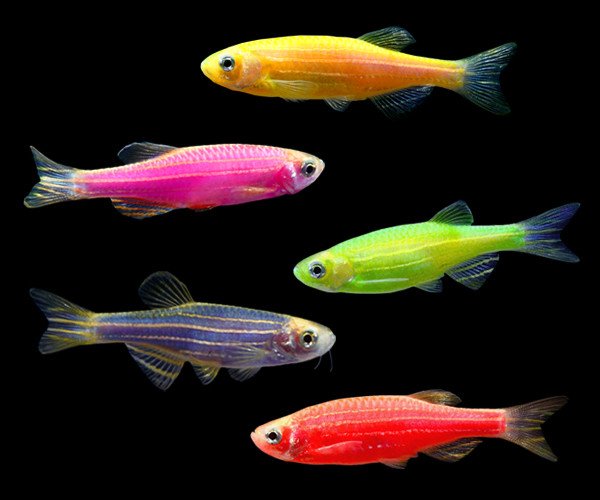
Fig. 1. Transgenic fluorescent danios (http://shop.glofish.com/products/glofish-danio-package).
According to our abservations, pike, Esox lucius,
another diurnal and crepuscular predator, does not avoid dull red
fluorescent zebrafish but avoid bright (UV illuminated) prey.
In the wild nature, visually guided
fish may include in their diets new and brightly colored prey but only
after long-term testing of these prey and formation of search image in
respect to these prey. For example, Hope (1984) has informed that wild
trout included in their diet an invasive species of beetles with bright
coloration only through about month of acquaintance with this new prey
and their testing.
Large fluorescent objects versus small fluorescent implants
It is necessary to distinguish large
fluorescent objects and small fluorescent implants used to tag fish. It
is shown (e.g., Catalano et al., 2001; Roberts & Kilpatrick, 2004)
that small but bright fluorescent implants may attract predators and
thus decrease the recapture rate of tagged fish in the nature.
Fluorescent fishing lines
It is shown that largemouth bass may
distiguish white, yellow and green fluorescent fishing lines but only
after several trials with attached worms to these lines (Miller &
Janzow, 1979).
Fishing practice. Part 1
There are fish habitats that allow to
confirm the attractiveness of red or orange fluorescent lures at the
statistic level. These habitats are rivers with clayish banks, clay pits
or clay ponds in which water may be very turbid especially under wind
and after rains.
Using one of these localities, we
tested soft plastic lures of red fluorescent color and ordinary red
color. Lures, namely curly tails of 3 cm length, were rigged in pairs at
the distance of 10-12 cm between each other. Fish could observe both
lures simultaneuosly for free choice, so the sign test for paired
comparisons was used for statistics.
Tests were carried out in summer in
clayish locality of Goryn river (Belarus). According to visual guide,
turbidity of the water was about 90 NTU (nephelometric turbidity units)
and more under wind. Red fluorescent lures were illuminated naturally in
the air under the sun light.
During 2 days of experiments, overall 39 fish were caught using standard spinning technique. They were adult perch, P. fluviatilis, and Donets ruffe, Gymnocephalus acerina, as well as juvenile pike, E. lucius, zander, Stizostedion lucioperca, asp, Aspius aspius, and chub, Leuciscus cephalus. Of these 39 fish, 28 fish preferred red fluorescent lures over ordinary red lures (sign test, P < 0.01).
However, in more or less clear waters
red or orange fluorescent lures may seem too bright and thus they may
deter or scare predatory fish.
It is known that mature males of three-spined sticklebacks, Gasterosteus aculeatus,
with the red breast aggresively attack other mature males and
artificial wooden red models (Darkov, 1980). According to our
observations in the nature, nest guarding males of sticklebacks attack
in the same manner approaching soft plastic shads (3 cm length) of
ordinary red color but avoid much more conspicuous red fluorescent shads
(additionally to sun light illuminated by LED lantern).
Fishing practice. Part 2
Other fish habitats suitable to use red
or orange fluorescent lures are river back waters, lakes and ponds in
which water is saturated with the soluble organic substances and
suspensions (like algae). In these habitats, for example, some natural
white maggots with one red fluorescent maggot can be more attractive for
carp, Cyprinus carpio, tench, Tinca tinca, and other
cyprinids than the same natural white maggots without one very visible
red fluorescent maggot. However, preferences of cyprinid fish to red or
orange fluorescent lures are not widespread, stable and suitable for
statistic confirmations because colors of baits are not prefered stimuli
for these fish.
Foraging carps and other large
bentivorous fish increase turbidity of water bodies (e.g., Richardson et
al., 1995; Roberts et al., 1995; Drenner et al., 1997; Sidorkewicj et
al., 1998) thus making these habitats suitable to use red or orange
fluorescent lures.
According to Sidorkewicj et al. (1998), tubidity induced by carps may achieve 100-140 NTU.
Note also, turbidity induced by carps decreases angler catch rates of other sport fish (Drenner et al., 1997).
Basic references
Breden F., Stoner G. 1987. Male predation risk determines female preference in the Trinidad guppy. Nature 329, 831-833
Catalano M.J., Chipps S.R., Bouchard
M.A., Wahl D.Y. 2001. Evaluation of injectable fluorescent tags for
marking centrarchid fishes: Retention rate and effects on vulnerability
to predation. North American Journal of Fisheries Management 21, 211-217
Cortemeglia C., Beitinger T.L. 2006. Susceptibility of transgenic and wildtype zebra danios, Danio rerio, to predation. Environmental Biology of Fishes 76, 93-100
Darkov A.A. 1980. Ecological features of visual signalization in fishes. Science Publishing, Moscow
Drenner R.W., Gallo K.L., Edwards C.M.,
Rieger K.E., Dibble E.D. 1997. Common carp affect turbidity and angler
catch rates of largemouth bass in ponds. North American Journal of Fisheries Menagement 17, 1010-1013
Dugas M.B., Franssen N.R. 2011. Nuptial coloration of red shiners (Cyprinella lutrensis) is more intense in turbid habitats. Naturwissenschaften DOI 10.1007/s00114-011-0765-4
Gong Z., Wan H., Tay T.L., Wang H.,
Chen M., Yan T. 2003. Development of transgenic fish for ornamental and
bioreactor by strong expression of fluorescent proteins in the skeletal
muscle. Biochemical and Biophysical Research Communications 308, 58–63
Greany P.D., Burditt A.K., Agee H.R., Chambers D.L. 1978. Increasing effectiveness of visual traps for the Caribbean fruit fly, Anastrepha suspensa (Diptera: Tephritidae), by use of fluorescent colors. Entomologia Experimentalis et Applicata 23, 20-25
Hawryshyn C.W., Arnold M.G., McFarland W.N., Loew E.R. 1988. Aspects of color vision in bluegill sunfish (Lepomis macrochirus): ecological and evolutionary relevance. Journal of Comparative Physiology A164, 107-116
Hill J.E., Kapuscinski A.R., Pavlowich
T. 2011. Fluorescent transgenic zebra danio more vulnerable to predators
than wild-type fish. Transactions of the American Fisheries Society 140, 1001-1005
Hope J. 1984. The well-lured trout. Science 84, 160-167
Jha P. 2010. Comparative study of aggressive behaviour in transgenic and wildtype zebrafish Danio rerio (Hamilton) and the flying barb Esomus danricus (Hamilton), and their susceptibility to predation by the snakehead Channa striatus (Bloch). Italian Journal of Zoology 77, 102-109
Kawamura G., Kishimoto T. 2002. Color vision, accomodation and visual acuity in the largemouth bass. Fisheries Science 68, 1041-1046
Kelley J.L., Phillips B., Cummins G.H.,
Shand J. 2012. Changes in the visual environment affect colour signal
brightness and shoaling behaviour in a freshwater fish. Animal Behaviour 83, 783-791
Kinney J.A.S., Luria S.M., Weitzman D.O. 1967. The visibility of colors underwater. Journal of the Optical Society of America 57, 802-807
Lescheva T.S., Zhuykov A.Y. 1989. Learning in fish. Ecological and applied aspects. Moscow, Science
Miller R.J., Janzow F.T. 1979. An experiment on visual discrimination in the largemouth bass, Micropterus salmoides. Proceedings of the Oklahoma Academy of Science 59, 34-40
Pocklington R., Dill L.M. 1995. Predation on females or males: who pays for bright male traits? Animal Behaviour 49, 1122-1124
Protasov V.R. 1978. Fish behaviour. The
mechanisms of fish orientation and their use in fishing. Food Industry
Publishing, Moscow
Richardson M.J., Whoriskey F.G., Roy L.H. 1995. Turbidity generation and biological impacts of an exotic fish Carassius auratus, introduced into shallow seasonally anoxic ponds. Journal of Fish Biology 47, 576-585
Roberts J., Chick A., Oswald L., Thompson P. 1995. Effect of carp, Cyprinus carpio L., an exotic benthivorous fish, on aquatic plants and water quality in experimental ponds. Marine and Freshwater Research 46, 1171-1180
Roberts J.H., Kilpatrick J.M. 2004. Predator feeding preferences for a benthic stream fish: effects of visible injected marks. Journal of Freshwater Ecology 19, 531-538
Seehausen O., van Alphen J.J.M., Witte
F. 1997. Cichlid fish diversity threatened by eutrophication that curbs
sexual selection. Science 277, 1808-1811
Sidorkewicj N.S., López Cazorla A.C.,
Murphy K.J., Sabbatini M.R., Fernandez O.A., Domaniewski J.C.J. 1998.
Interaction of common carp with aquatic weeds in Argentine drainage
channels. Journal of Aquatic Plant Management 36, 5-10
Utne-Palm A.C. 2002. Visual feeding of fish in a turbid environment: physical and behavioural aspects. Marine and Freshwater Behaviour and Physiology 35, 111–128